
Strike Off Company: How to Close a Limited Company
Want to strike off a company? Voluntary strike-off lets eligible UK limited companies close and be removed from the Companies House register.
Learn how to apply using form DS01, settle your final accounts and Corporation Tax, notify creditors and shareholders, and avoid costly mistakes before dissolution.
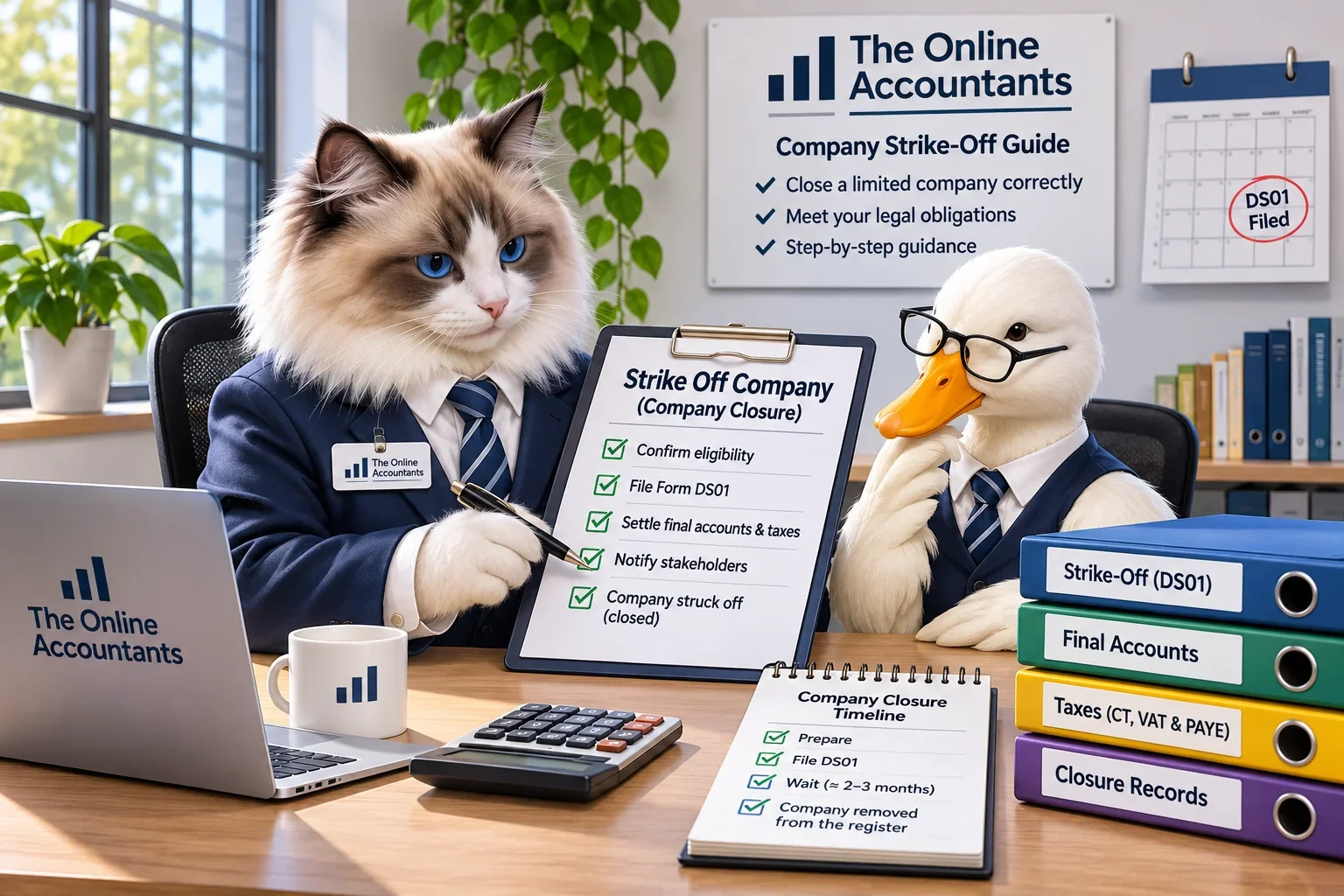
Updated November 2026 · Prepared by The Online Accountants, ACCA-qualified UK accountants. The Gazette notice period begins after publication; the overall process takes longer.
To strike off a limited company in the UK, you must ensure the company qualifies for voluntary dissolution, stop trading, settle its liabilities, deal with remaining assets, complete the appropriate tax obligations and submit an application to Companies House.
The application is commonly known as form DS01. Once accepted, Companies House publishes a notice in The Gazette. If no valid objection prevents the process, the company can be dissolved after the statutory notice period.
What does it mean to strike off a company?
Company strike-off is the process of removing a company from the official register maintained by Companies House. Once the company is dissolved, it ceases to exist as a separate legal entity.
Voluntary strike-off is generally used where a solvent company is no longer required. For example, the directors may be retiring, the business may have stopped trading, or a company may have been incorporated but never used.
Directors apply to close an eligible company that is no longer required.
Companies House initiates removal, potentially because of failures to comply with filing obligations.
A formal winding-up procedure that may be more appropriate where the company has substantial assets or financial difficulties.
Strike-off should not be used as a shortcut to avoid paying creditors, Corporation Tax or other liabilities. Dissolution does not necessarily prevent subsequent restoration, creditor action or investigation of directors' conduct.
Can I strike off my company?
Before submitting DS01, check the statutory eligibility requirements. A company generally must not have traded or carried on business during the previous three months, changed its name during that period, or be involved in prohibited insolvency proceedings or creditor arrangements.
Company strike-off eligibility checker
Answer five questions for an initial indication of whether voluntary strike-off may be suitable.
This screening tool is indicative only. It does not assess every restriction in sections 1004–1005 Companies Act 2006, including certain disposals and activities within the preceding three months. It is not a legal eligibility determination.
How to strike off a limited company: step by step
Following the correct sequence helps prevent objections, delays and unexpected tax liabilities.
Stop trading and confirm eligibility
Cease ordinary business activities and establish when trading ended. Permitted activities to conclude the company's affairs, obtain advice or comply with statutory requirements may still take place. Review the three-month restrictions before applying.
Settle outstanding debts and collect money owed
Pay suppliers, lenders, employees and HMRC. Recover outstanding customer balances, settle director loan accounts and review contingent liabilities. If the company cannot pay its debts, obtain insolvency advice.
Prepare final accounting and tax information
Establish the final trading position, calculate Corporation Tax, review the need for outstanding CT600 returns and notify HMRC of cessation. Deal with VAT, PAYE and other registrations where applicable.
Deal with company assets and bank accounts
Dispose of or properly transfer remaining assets, including equipment, intellectual property, domain names and cash. Consider tax consequences before making shareholder distributions. Complete any refunds and banking arrangements before dissolution.
Submit the strike-off application
Apply through the Companies House online service or use paper form DS01 if necessary. The application requires approval from a majority of directors. Where there are two directors, both must sign.
Notify affected parties within seven days
Provide a copy of the application to relevant shareholders, creditors, employees, pension trustees and any directors who did not sign. Further notification duties may arise if new interested parties appear before dissolution.
Monitor The Gazette and confirm dissolution
Companies House publishes a proposed strike-off notice. If no valid objection prevents dissolution, a second Gazette notice confirms that the company has been struck off. Retain your closure and tax records.
How much does it cost to strike off a company?
The Companies House fee depends on whether you apply online or by post. The following fees have applied since 1 February 2026.
Online voluntary strike-off application.
Paper DS01 application, generally for applicants unable to use the online service.
Accountancy, tax preparation, professional advice and settling outstanding liabilities where required.
These are statutory application fees, not the total cost of closing a company. An accountant may need to prepare final tax computations, resolve director loans or advise on distributing retained profits.
How long does striking off a company take?
Once Companies House accepts an application, it publishes a notice in The Gazette. The company cannot ordinarily be struck off until at least two months after that notice.
Allow additional time for Companies House processing, Gazette publication, objections and any work needed to settle tax or other obligations. The overall closure process commonly takes several months, and the initial three-month trading restriction may extend the preparation period.
Do you need final accounts before striking off a company?
Closing a limited company does not automatically remove its existing accounting or tax obligations. The correct treatment depends on the company's circumstances, the dates involved and any notices issued by HMRC.
Corporation Tax and the final CT600
The company should establish its taxable profits up to cessation, calculate any Corporation Tax due and address outstanding returns or HMRC filing notices. HMRC has specific arrangements for certain final accounting periods where a company is being struck off, but these should not be assumed to apply automatically.
Where a Company Tax Return is required, it must be filed in accordance with the applicable rules. If dissolution is delayed, existing filing obligations and penalties may remain relevant.
See our guides to CT600 Corporation Tax Returns, Corporation Tax payment deadlines and filing limited company accounts.
VAT, PAYE and payroll
VAT-registered companies normally need to cancel their VAT registration when they cease taxable business activities, complete outstanding VAT returns and consider VAT due on retained assets.
Employers must deal with final payroll submissions, outstanding PAYE and National Insurance, employee payments and any applicable redundancy obligations. Construction Industry Scheme obligations should also be reviewed where relevant.
Director's loan accounts
An outstanding overdrawn director's loan can create additional tax and reporting issues. Writing off a loan, repaying it or treating an amount as a distribution may have materially different consequences.
Review our Director's Loan Account guide before making final entries.
What is the £25,000 rule when striking off a company?
One of the most important tax considerations is how money and assets are distributed to shareholders before the company is dissolved.
Under Corporation Tax Act 2010 section 1030A, qualifying distributions made in anticipation of dissolution may be treated as capital rather than income where the relevant conditions are satisfied and the total distributions do not exceed £25,000.
The £25,000 threshold applies to the aggregate qualifying distributions, not as a separate allowance for each shareholder. It is not an automatic tax-free amount.
| Situation | Potential tax treatment | Consideration |
|---|---|---|
| Qualifying distributions totalling £25,000 or less | Potential capital treatment | Capital Gains Tax and any applicable reliefs should be considered. |
| Distributions exceeding £25,000 | Ordinarily income treatment under the strike-off route | Dividend taxation may apply. Do not assume only the excess is affected. |
| Members' Voluntary Liquidation | Potential capital distributions | Liquidator fees, shareholder tax, eligibility and anti-avoidance rules require review. |
Example: closing a company with £20,000
Assume a solvent company has settled all its liabilities and has £20,000 available for distribution. If the statutory conditions are satisfied, the distribution may qualify for capital treatment. The shareholder's actual tax liability will depend on their share base cost, other gains, available allowances and reliefs.
Example: closing a company with £60,000
Where the intended distribution is £60,000, the £25,000 strike-off capital treatment limit is exceeded. The directors should compare the likely income tax consequences with the costs and potential capital treatment of a formal Members' Voluntary Liquidation.
Related reading: Business Asset Disposal Relief and How to Pay Yourself from a Limited Company.
Can you strike off a company with debts?
Directors should not use voluntary strike-off to evade debts. Creditors, including HMRC, can object to an application and may seek restoration of a company that has already been dissolved.
A company with unpaid debts is not automatically barred from applying in every circumstance, but insolvency, threatened liquidation, prohibited arrangements and other statutory restrictions can make voluntary strike-off inappropriate or unlawful.
Where a company cannot pay its debts as they fall due or has liabilities exceeding its assets, directors should obtain qualified insolvency advice before taking action.
What happens if HMRC objects to strike-off?
HMRC may object where it believes tax obligations remain unresolved. An objection can suspend the dissolution process until the relevant matters are addressed. Filing the DS01 does not cancel Corporation Tax, VAT or PAYE debts.
Can Companies House strike off a company automatically?
Companies House can initiate compulsory strike-off in certain circumstances, including where a company appears not to be operating or fails to meet statutory requirements. This is different from directors applying voluntarily and is not a substitute for completing proper closure procedures.
If you receive a compulsory strike-off notice but want to retain the company, act promptly to resolve the reason for the notice, including outstanding filings where applicable.
Company strike-off checklist
Use this checklist to organise the closure process. Your progress is kept for the current browser tab session, where browser storage is available.
Your company closure progress
This checklist is a planning aid. Marking an item complete does not constitute professional verification or legal compliance.
Strike-off, dormancy or liquidation: which is better?
| Option | Typically suitable for | Key difference |
|---|---|---|
| Voluntary strike-off | Eligible companies no longer required | Relatively inexpensive route to dissolution. |
| Keep the company dormant | Owners who may use the company again | The company continues to exist and has ongoing obligations. |
| Members' Voluntary Liquidation | Solvent companies, often with significant assets | Formal liquidator-led closure with potentially different tax treatment. |
| Creditors' Voluntary Liquidation | Insolvent companies requiring formal winding-up | A licensed insolvency practitioner manages the process. |
Where the directors intend to start a similar business after closing the existing company, specialist tax advice may also be needed because targeted anti-avoidance rules can affect the treatment of distributions.
Frequently asked questions about striking off a company
Can I strike off my limited company myself?
Yes. Eligible directors can apply directly through Companies House without appointing an accountant. However, professional assistance may be useful for final accounts, Corporation Tax, director loans, shareholder distributions or unresolved liabilities.
What is a DS01 form?
DS01 is the Companies House application for voluntary strike-off. It requires the approval of a majority of directors and can usually be completed through the online company closure service.
Is striking off a company free?
No. The Companies House application costs £13 online or £18 on paper under the fees effective from 1 February 2026. Additional accounting, tax or professional costs may arise.
Can I strike off a dormant company?
Yes, a dormant company may be eligible if it satisfies the statutory requirements. You should still review its outstanding filings, assets, liabilities and tax position before applying.
Can I strike off a company that has never traded?
Generally yes, provided it meets the eligibility criteria and any outstanding obligations have been addressed. A company that never traded may have a simpler closure process, but this does not eliminate all statutory responsibilities.
Do I need to tell HMRC before striking off?
HMRC should be informed of the closure and any relevant Corporation Tax, VAT, PAYE or other tax matters resolved. HMRC is also a relevant creditor or interested party where applicable and may object to dissolution.
What happens to money left in the company bank account?
After dissolution, the bank account is frozen and remaining company assets, including bank balances, generally pass to the Crown as bona vacantia. Resolve cash balances and asset ownership before dissolution.
Can I withdraw a strike-off application?
Yes, while the company remains on the register. Withdrawal is required if the company becomes ineligible, and is also possible if the directors change their minds. The online service or form DS02 can be used as appropriate.
Can a dissolved company be restored?
In some circumstances, yes. Administrative or court restoration may be possible depending on the reason for dissolution, the applicant and applicable time limits. Restoration may be needed to recover assets or pursue claims.
Does strike-off remove personal liability for directors?
No. Dissolution does not automatically eliminate personal guarantees, liabilities arising from misconduct or other legal responsibilities. Directors should obtain advice where there are potential claims or financial difficulties.
What is the difference between strike-off and liquidation?
Strike-off is an administrative dissolution procedure for eligible companies. Liquidation is a formal winding-up process involving a liquidator. The costs, legal procedures and shareholder tax consequences can differ significantly.
Can I reopen a company after it has been struck off?
A dissolved company cannot simply resume trading. Restoration may be possible in qualifying circumstances, or the owners may choose to incorporate a new company. Tax and legal considerations should be reviewed first.
Closing your limited company? Get the accounting right first.
We help UK company directors understand their accounting and Corporation Tax responsibilities, prepare outstanding accounts and review tax matters before company closure.
ACCA-qualified accountants · Nationwide online service · Dedicated point of contact.
Contact Our Accountants View Company Accounts FilingWhere formal insolvency or liquidation advice is needed, a licensed insolvency practitioner or appropriately qualified legal adviser may be required.
About this guide: Prepared by The Online Accountants, a trading name of Parkinson (UK) Limited. Reviewed November 2026. General information for UK limited company directors; individual legal and tax circumstances may differ.