
Restore Dissolved Company: UK Guide 2026
Has your limited company been struck off the Companies House register? Discover how to restore a dissolved company, what it costs, who can apply and how to deal with outstanding accounts and filings.

Can You Restore a Dissolved Limited Company?
Yes. A dissolved company can often be brought back onto the Companies House register, provided the relevant legal conditions are met.
When a company is dissolved, it ceases to exist as a legal entity. Its bank accounts may be frozen, assets can pass to the Crown and the business cannot simply resume operating as though nothing happened.
Restoration reverses the dissolution. Once restored, the company is generally treated in law as having continued in existence as if it had not been dissolved, subject to any directions made by the court and other applicable legal requirements.
Administrative Restoration
An application made directly to Companies House, normally using form RT01. It is available only where the statutory conditions are satisfied, including the relevant circumstances of registrar-initiated strike-off.
Restoration by Court Order
A court application may be necessary where the company was voluntarily struck off, the applicant is not eligible for administrative restoration, or other circumstances require judicial approval.
Which Company Restoration Route Might Apply?
Answer three questions to identify the route most likely to require investigation. This is an initial guide, not a legal eligibility decision.
Administrative Restoration vs Court Restoration
| Feature | Administrative | Court Order |
|---|---|---|
| Application route | Companies House | Appropriate court |
| Typical applicant | Former director or member | Broader range of eligible interested parties |
| Voluntary strike-off | Not generally available | Usually required |
| Application fee | £341 | Court fees and other costs apply |
| Time limit | Generally six years | Generally six years, with exceptions |
| Professional support | Accountancy and filing support | Legal advice plus accountancy support |
Fees and eligibility should be checked against current Companies House and court guidance before applying.
How to Restore a Company Administratively
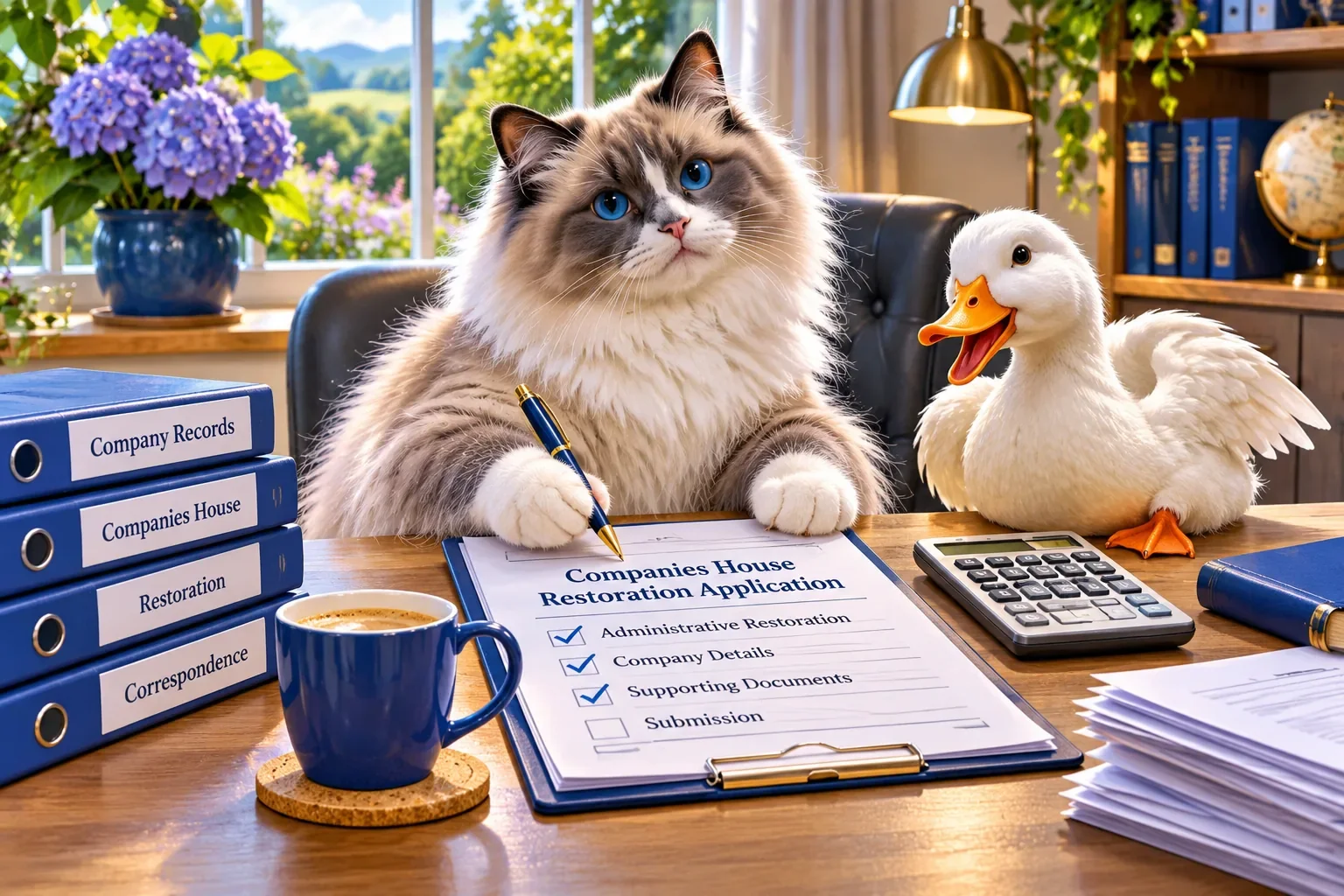
Administrative restoration is generally the simpler route where a company was dissolved following qualifying action by the Registrar of Companies.
A former director or member must satisfy the relevant legal conditions. For the usual registrar strike-off cases, the company must also have been carrying on business or in operation at dissolution.
The application generally requires outstanding company filings, payments and evidence concerning any assets that passed to the Crown.
Administrative Restoration: Step by Step
Confirm the company number, dissolution date, strike-off history and outstanding filing obligations.
Establish whether the former director or member can apply and whether the company meets the applicable restoration conditions.
Identify accounts, confirmation statements and other documents that should have been filed before dissolution. Calculate outstanding fees and penalties.
If company property passed to the Crown, obtain the appropriate waiver or consent documentation from the relevant Crown representative.
Send the application, supporting documents and applicable payments to Companies House using the current published instructions.
Once restoration is confirmed, check the register, statutory records, tax position and any remaining filing or compliance requirements.
The official form is available from GOV.UK — Administrative Restoration RT01 .
How Much Does It Cost to Restore a Dissolved Company?
The total cost depends on the restoration route, the number of overdue filings, outstanding penalties and whether professional assistance is needed.
| Cost item | What to allow for |
|---|---|
| Companies House RT01 fee | £341 |
| Bona vacantia waiver | £64 where the published Bona Vacantia Division fee applies |
| Overdue accounts | Preparation costs and applicable filing penalties |
| Confirmation statements | Applicable outstanding filing fees |
| Court restoration | Court fees, legal fees and other case-specific costs |
| Accountancy assistance | Depends on the records and outstanding work |
For general company accounts preparation and filing, see our fixed-fee company accounts service and accountancy fees. Our advertised filing packages do not automatically include company restoration, historic catch-up work or legal fees.
Restoring a Dissolved Company Through the Courts
Court restoration is commonly necessary when the directors voluntarily dissolved the company or administrative restoration is unavailable.
Eligible applicants can include former directors, members, creditors and certain other parties with a qualifying interest.
In England and Wales, restoration proceedings commonly involve a Part 8 claim using form N208, supporting evidence and an application to the appropriate court. Procedures differ in Scotland and Northern Ireland.
Court proceedings require careful legal consideration. We recommend obtaining advice from a solicitor experienced in company restoration.
When Might a Court Order Be Needed?
- The directors voluntarily struck off the company.
- A creditor needs to pursue a claim against a dissolved company.
- The applicant is not eligible for administrative restoration.
- Company assets or property rights require restoration.
- The circumstances involve insolvency or another complex dissolution.
- Companies House has refused administrative restoration and court relief may be available.
For official guidance see Companies House guidance on restoring companies .
What Happens to a Dissolved Company's Money and Assets?
When a company is dissolved, certain assets belonging to it immediately before dissolution can become bona vacantia, meaning ownerless property that passes to the Crown under the applicable law.
This can affect bank balances, property and other assets. The position depends on the type of asset, the company's circumstances and the relevant jurisdiction.
Money in a Company Bank Account
A bank may freeze or close the account following dissolution. Restoration may be necessary before the company can seek to recover its funds.
Property and Other Assets
Land, buildings and other assets can create additional legal issues, including Crown interests, disclaimers and third-party rights. Specialist advice may be needed.
Restoration does not guarantee that every asset will be immediately recoverable. Where the Crown has disposed of or disclaimed property, further legal questions may arise.
Company Restoration Document Checklist
Use this interactive checklist to organise your initial information before approaching Companies House, an accountant or a solicitor.
0 of 12 items checked
Checklist selections are held only in the current page session and are not submitted to our practice.
What Happens After a Company Is Restored?
A successful restoration is an important milestone, but it does not necessarily complete the company's administrative and tax obligations.
Directors should review outstanding Companies House filings, statutory records, HMRC correspondence, banking arrangements and the company's financial position.
If the company intends to resume trading, it should also check that any necessary registrations, authorisations and insurance arrangements are appropriate before restarting activities.
Key Actions Following Restoration
- Confirm that Companies House shows the company as active.
- Review outstanding statutory accounts and confirmation statements.
- Reconcile bookkeeping records and historic transactions.
- Contact HMRC where tax registrations or liabilities require attention.
- Check the position of bank accounts and company assets.
- Review director and beneficial ownership information.
- Consider Companies House identity verification requirements.
- Confirm that the company is ready to resume trading lawfully.
You may also find our guides to filing a confirmation statement, striking off a company and Authorised Corporate Service Providers helpful.
Common Reasons People Need to Restore a Company
Example 1: Accounts Were Never Filed
A small company stops trading and fails to file accounts. Companies House eventually strikes it off. The former director wants to resume business.
Consideration: Administrative restoration may be possible if the relevant conditions are met. Outstanding filings and penalties must be reviewed.
Example 2: A Bank Account Still Holds Money
A company was voluntarily dissolved but funds remained in its bank account.
Consideration: Court restoration may be necessary to recover the funds. The bona vacantia position should be investigated before proceeding.
Example 3: A Creditor Is Owed Money
A supplier discovers that a customer company has been dissolved before settling its debt.
Consideration: The creditor may have grounds to seek court restoration, but recovery of the debt is a separate question.
Example 4: A Property Was Left Behind
A dissolved property company previously owned land or a building.
Consideration: The legal ownership, Crown interest and restoration route require careful investigation, usually with specialist legal advice.
These are illustrative scenarios, not representations of actual client engagements or guaranteed outcomes.
How Can an Accountant Help Restore a Dissolved Company?
An accountant can help establish the financial position and prepare the statutory accounting work required as part of a restoration.
Accounting and Filing Support
- Review available company records.
- Identify missing statutory accounts.
- Prepare outstanding accounts where instructed.
- Review Corporation Tax obligations.
- Identify filing fees and potential penalties.
- Assist with bookkeeping reconciliation.
When Legal Advice Is Needed
- Preparing and conducting court proceedings.
- Determining contested legal rights.
- Handling complex bona vacantia issues.
- Resolving property ownership disputes.
- Assessing limitation exceptions.
- Advising on insolvency-related restoration.
Restore Dissolved Company FAQs
Can I restore a dissolved company after six years?
Generally, restoration applications are subject to a six-year limit. Exceptions exist, including certain personal injury proceedings and specific statutory circumstances. Specialist legal advice is important where the deadline has passed.
How much is the Companies House restoration fee?
The administrative restoration application fee is £341 as published for 2026. Other expenses may include a bona vacantia waiver, overdue filings, penalties and professional fees.
Can I restore a company that I voluntarily struck off?
Yes, potentially, but voluntary strike-off generally requires restoration through the courts rather than the administrative RT01 procedure.
How long does restoring a dissolved company take?
There is no single guaranteed timeframe. The time depends on the route, completeness of documents, outstanding filing work and, where applicable, court availability and legal issues.
Can a dissolved company get its bank account money back?
Restoration may allow the company to seek recovery of funds, but the position depends on whether the money passed to the Crown and what happened to it after dissolution. Recovery is not automatic.
Do I need an accountant to restore a company?
Not necessarily. However, professional accounting assistance can be valuable where statutory accounts, tax returns, historic bookkeeping or other financial records need to be prepared or corrected.
Do I need a solicitor for company restoration?
For court restoration, obtaining specialist legal advice is strongly recommended. Administrative restoration may be handled without court proceedings if all eligibility conditions are satisfied.
Will the restored company have the same company number?
Yes. Restoration revives the original company rather than creating a new legal entity, so its registration number remains the same.
What happens to outstanding accounts after restoration?
Outstanding accounts and other statutory documents must be considered as part of the restoration process. The treatment of filing deadlines and penalties can differ between administrative and court restoration.
Can a creditor restore a dissolved company?
A qualifying creditor may be able to apply for restoration through the courts. Restoring the company does not itself establish or guarantee payment of the debt.
Can a company dissolved after insolvency be restored?
Court restoration may be available in certain insolvency-related circumstances. The relevant statutory provisions, purpose of restoration and applicant's standing require specialist consideration.
Can I start trading before the company is restored?
A dissolved company no longer exists as a legal entity and should not be treated as an active company. Obtain appropriate advice before entering transactions or restarting activities in its name.
Need Help With a Dissolved Company's Accounts?
Whether you need to identify outstanding accounts, bring bookkeeping up to date or understand the financial filing requirements associated with restoration, our UK online accountancy practice can discuss the work involved.
Contact The Online AccountantsACCA-Registered Practice · UK-Wide Online Support · No Long-Term Contracts
Guide reviewed: 21 November 2026. General information only. Company restoration law, fees and procedures may change. Check current Companies House guidance and obtain legal advice where necessary.